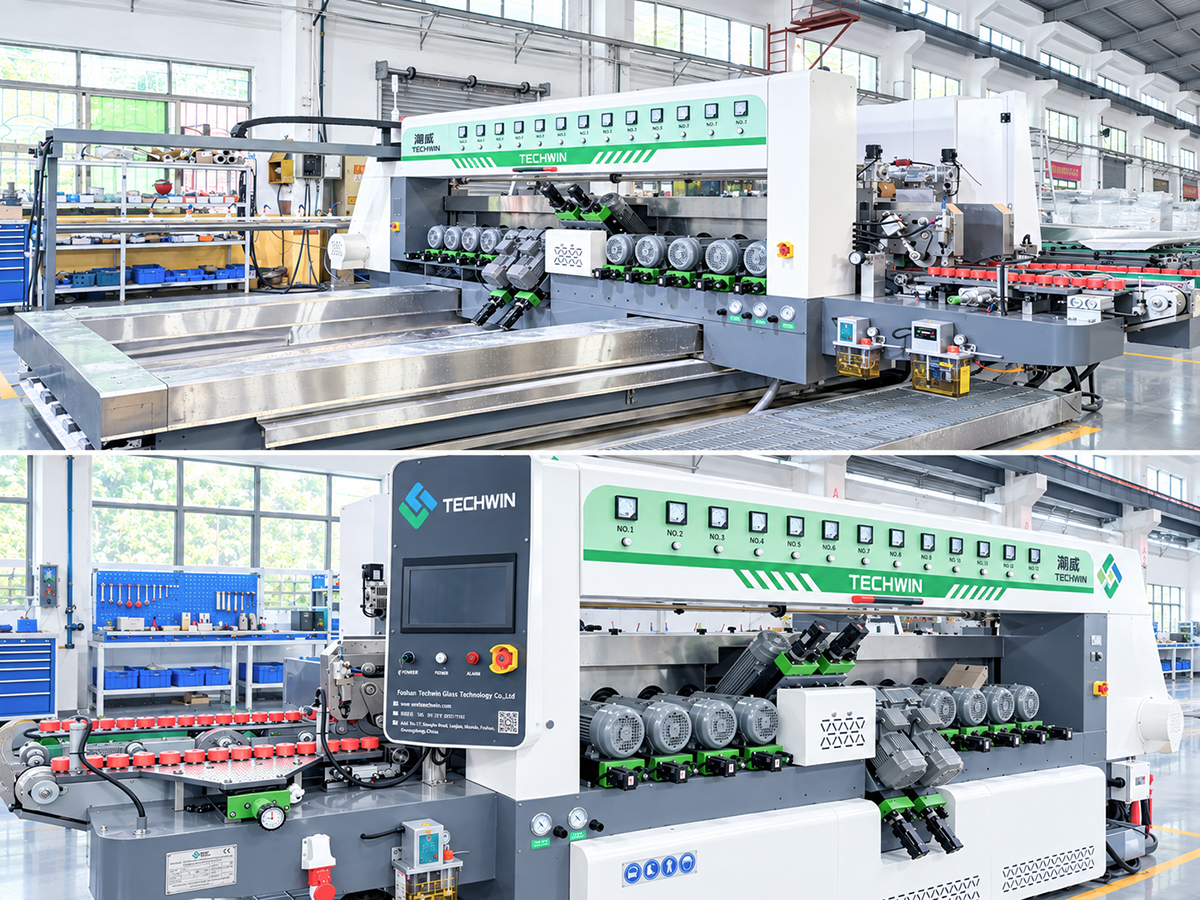
A glass double edger processes the two parallel edges of a glass sheet simultaneously.
Compared with processing one edge at a time, a double edging machine can improve production efficiency and provide consistent dimensional control for high-volume glass processing.
A typical automatic double edging line consists of:
Measuring Conveyor → First Double Edger → Transfer/Turning Table → Second Double Edger → Outfeed
The exact configuration depends on the glass application, required edge finish, glass dimensions and production speed.
1. Glass Feeding
The glass sheet enters the line through the feeding conveyor.
Before processing, the system can measure the glass dimensions and position the sheet accurately.
Accurate positioning is important because the distance between the two processed edges determines the final glass width.
For automated production, scanning or measuring systems can be integrated into the feeding section.
2. First Double Edger
The first double edger processes two opposite edges of the glass simultaneously.
Depending on the machine configuration, the grinding system may include:
- Rough grinding spindles
- Fine grinding spindles
- Polishing spindles
- Low-E removal units
The number and type of spindles depend on the required edge finish and production application.
3. Glass Transfer and Turning
After the first edging operation, the glass is transferred to the next processing section.
An I/L-shaped transfer system can be used depending on the factory layout.
The transfer system needs to maintain accurate glass positioning while moving the sheet between machines.
4. Second Double Edger
The second double edger processes the remaining two edges.
After this operation, all four edges of the glass have been processed.
A typical line therefore provides:
First Edger → Two Parallel Edges
Second Edger → Remaining Two Edges
This configuration is particularly useful for high-volume rectangular glass production.
5. Grinding Spindles
Grinding spindles are the core processing components of a double edger.
Different spindle configurations can be selected according to the required edge finish.
For example:
- Rough grinding for material removal
- Fine grinding for edge refinement
- Polishing for higher surface quality
- Corner dubbing
- Low-E removal for specific applications
The spindle configuration should be selected according to glass thickness, edge requirements and production speed.
6. Servo Technology
Servo motors can be used in glass double edging lines to improve positioning and machine response.
Servo-controlled opening and positioning systems can provide:
- Faster adjustment
- More accurate positioning
- Improved repeatability
- Better adaptation to different glass sizes
The actual performance depends on machine configuration, glass specifications and production conditions.
7. Automatic Glass Measurement
Automatic scanning and positioning can be integrated into the feeding system.
The system can identify the glass dimensions and adjust the machine accordingly.
This reduces dependence on manual measurement and can improve production consistency when processing different glass sizes.
For mixed-size production, automatic measurement can be particularly useful.
8. Glass Double Edger Production Speed
The production speed of a double edger depends on:
- Glass dimensions
- Glass thickness
- Edge removal amount
- Grinding configuration
- Required edge finish
- Operator feeding method
- Automation level
For high-speed lines, the complete material flow must be considered rather than focusing only on the maximum machine speed.
9. Double Edger vs. Single Edger
A single edger generally processes one edge or one processing path at a time.
A double edger processes two parallel edges simultaneously.
| Feature | Single Edger | Double Edger |
|---|---|---|
| Processing method | One side/path | Two parallel edges |
| Production efficiency | Lower for high-volume work | Higher for suitable applications |
| Automation potential | Available | High |
| Dimensional consistency | Depends on process | Strong potential with automatic positioning |
| Suitable production | Flexible/smaller production | Medium- and high-volume production |
The appropriate machine depends on production volume, glass dimensions and product mix.
10. Typical Double Edger Applications
Double edging lines can be used for:
- Architectural glass
- Shower glass
- Furniture glass
- Appliance glass
- Laminated glass
- Insulating glass production
- Solar-related glass processing
- Other flat-glass applications
The machine configuration should be adapted to the specific glass product.
11. How to Choose a Glass Double Edger
Before selecting a machine, define:
- Maximum glass size
- Minimum glass size
- Glass thickness
- Required edge finish
- Production speed
- Daily production volume
- Glass mix
- Low-E requirements
- Automation requirements
- Factory layout
A high-speed machine is not necessarily the correct solution if the upstream and downstream processes cannot match its production capacity.
TECHWIN Glass Double Edging Solutions
TECHWIN designs double edging machines and complete double edging lines for different glass-processing requirements.
A typical automatic line can include:
Measuring Conveyor
↓
First Double Edger
↓
I/L Turning or Transfer Table
↓
Second Double Edger
↓
Outfeed Conveyor
The line can be configured with automatic measurement, servo positioning, different grinding spindle arrangements and integrated conveying systems.
FAQ
What does a double edger do?
It processes two parallel edges of a glass sheet simultaneously.
Can a double edger process all four edges?
Yes. In a complete double-edging line, the first machine processes two edges and the second machine processes the other two.
Can a double edger process Low-E glass?
Yes, when the machine is configured with an appropriate Low-E edge-removal system.
Can a double edger process different glass sizes?
Yes. Automatic measurement and positioning systems can help the line adapt to different glass dimensions within the machine’s specified range.
Request a Double Edging Line
If you know your glass size, thickness, edge requirements and target production speed, TECHWIN can develop a suitable double edging configuration around your production process.
Contact TECHWIN to discuss your glass double edging requirements.