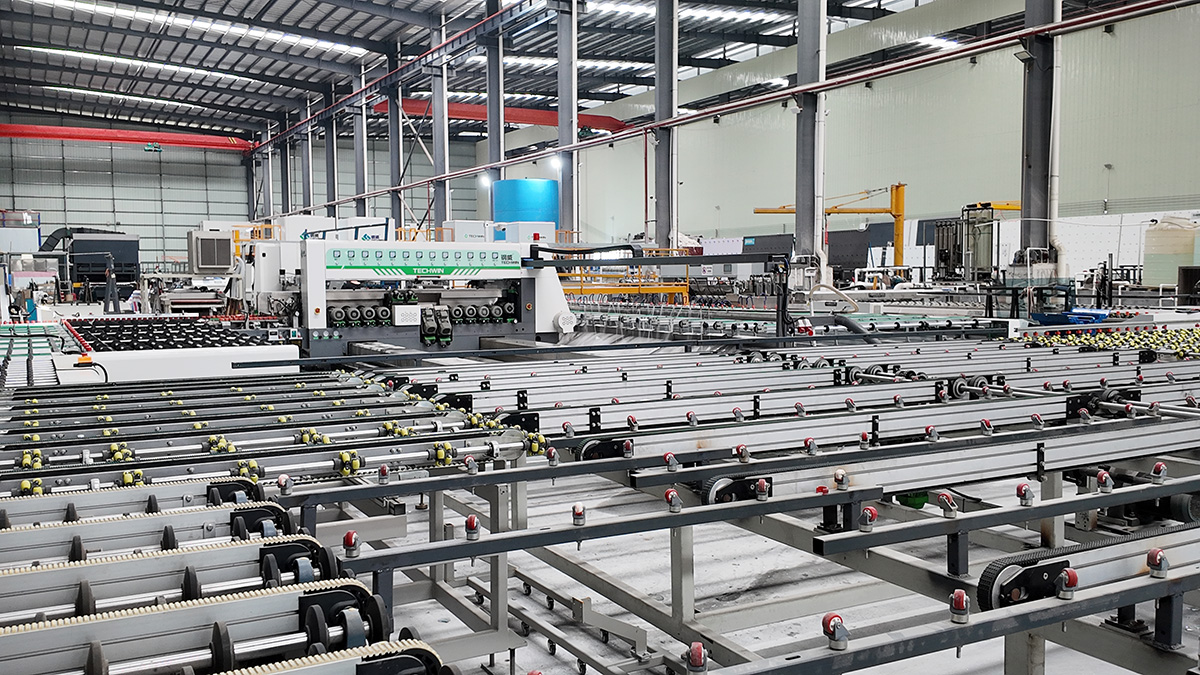
A glass washing machine must do more than clean the glass surface. It must also remove residual water so that the glass can proceed to the next production stage.
If glass comes out wet, with droplets on its surface or water remaining along its edges, the problem may affect production efficiency and downstream quality.
Before changing machine settings, identify where the moisture remains and whether the problem affects every glass sheet or only certain sizes and thicknesses.
1. Insufficient Airflow from the Blower
The drying section relies on an adequate supply of air to remove water from the glass surface.
If airflow is reduced, water may remain even when the washing section is functioning correctly.
What to check:
- Whether the blower is operating normally.
- Whether air filters are dirty or blocked.
- Whether air ducts or connecting hoses are obstructed or damaged.
- Whether the air-delivery system is operating according to the machine specifications.
Inspect and maintain the system according to the manufacturer’s instructions. Do not open or service powered equipment without following the required isolation procedures.
2. Incorrect Air-Knife Position
Air knives direct airflow across the glass surface. If their position or angle is incorrect, water may not be removed evenly.
Possible symptoms include wet edges, long water streaks, or moisture remaining in particular areas.
Recommended action:
Check the air-knife position against the manufacturer’s specified settings. Confirm that the air-delivery path is unobstructed and that the equipment is suitable for the glass thickness and size being processed.
Do not copy settings from another machine model without checking compatibility.
3. Excessive Conveyor Speed
The glass must pass through the drying section at a speed that allows sufficient water removal.
If the line operates too quickly for the existing drying capacity, moisture may remain on the glass.
To investigate, compare the drying results at the normal production speed and at a lower speed within the machine’s approved operating range. Keep the glass type and other conditions consistent.
If drying improves significantly at the lower speed, review the relationship between line speed and drying capacity before increasing production again.
4. Excessive Water Entering the Drying Section
The drying system may be working normally but receiving more water than it can effectively remove.
Investigate the rinsing stage, water flow, drainage, and the condition of the relevant conveyor components. Check whether water is being carried into the dryer unevenly.
If water is concentrated along one edge, record the glass orientation and inspect the relevant areas of the machine rather than adjusting the entire system immediately.
5. Dirty Filters or Obstructed Air Passages
Dust accumulation and blocked filters can reduce airflow and make drying inconsistent.
Establish a routine for checking accessible filters and air passages. Record cleaning dates and investigate whether the problem returns unusually quickly.
Maintenance intervals should reflect the operating environment, production hours, and the manufacturer’s recommendations.
6. Troubleshooting by Symptom
| Symptom | Possible cause | First check |
|---|---|---|
| Entire glass surface remains wet | Insufficient airflow or excessive line speed | Blower, filters, operating speed |
| Glass center is dry but edges are wet | Uneven air coverage or water carryover | Air-knife position and edge-water pattern |
| Only large sheets remain wet | Drying capacity or coverage may be insufficient | Glass dimensions and approved operating parameters |
| Drying becomes worse over time | Filter contamination or maintenance issue | Filter condition and maintenance records |
| Results vary between glass types | Different water loads, thicknesses, or processing conditions | Compare glass type and line settings |
These are initial checks. Confirm the root cause before making permanent adjustments.
7. How to Improve Drying Consistency
For reliable results, evaluate the complete washing process:
- Ensure the conveying system transports glass smoothly.
- Confirm that pre-rinsing and brushing remove contaminants effectively.
- Maintain the washing and rinsing water systems.
- Verify that the drying system delivers the required airflow.
- Match conveyor speed to the approved processing conditions.
- Inspect the glass immediately after unloading under suitable lighting.
Record the glass size, thickness, line speed, defect location, and relevant machine settings whenever a drying problem occurs. This makes repeated faults easier to diagnose.
Conclusion
Glass that remains wet after washing may indicate insufficient airflow, incorrect air-knife positioning, excessive conveyor speed, or excessive water carryover into the drying section.
A systematic inspection is more effective than changing several settings simultaneously.
TECHWIN supplies industrial glass washing machines for different glass-processing applications. Contact TECHWIN to discuss drying requirements, production capacity, and the most suitable configuration for your glass products.